
Hybrid Bearings
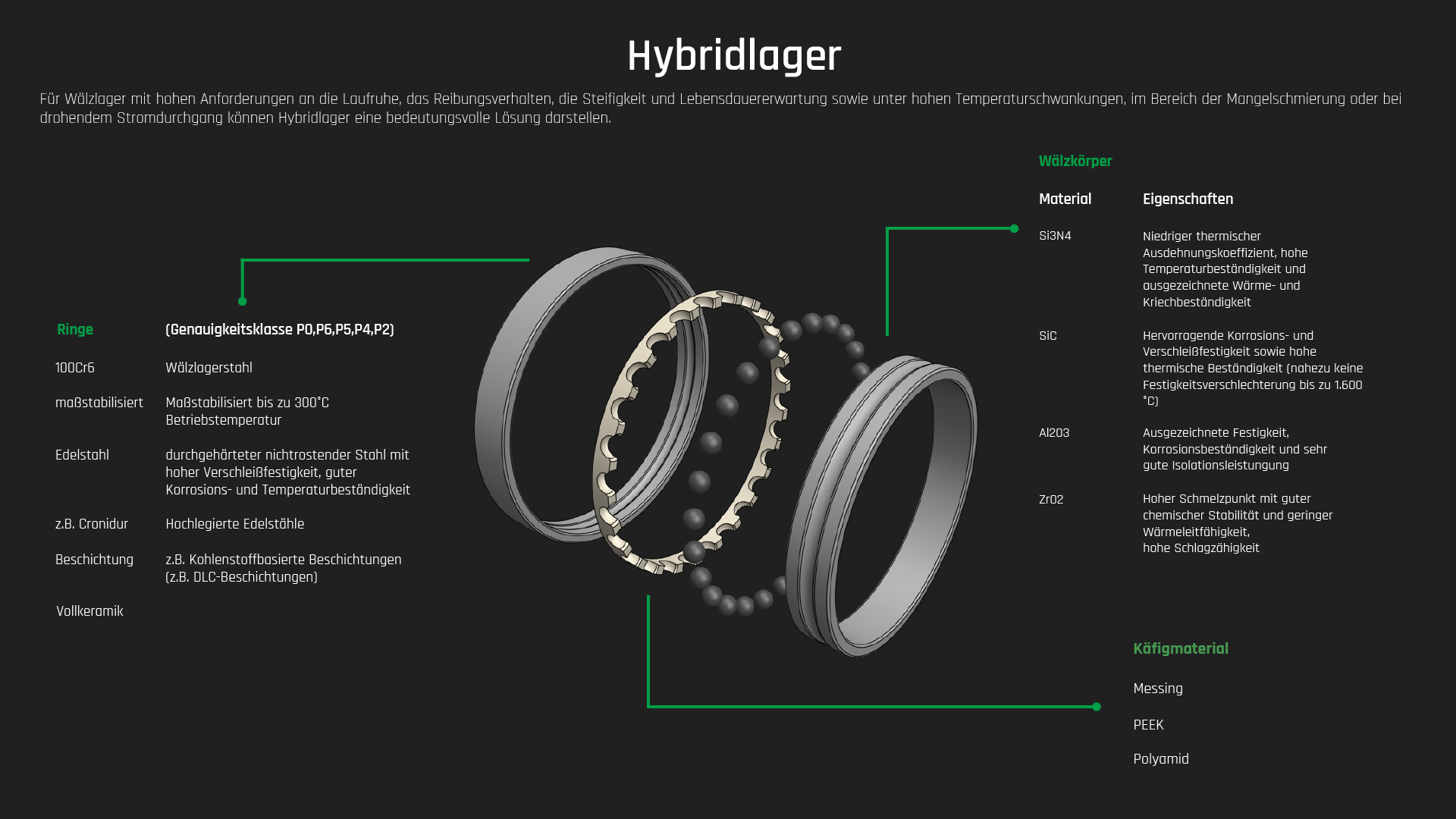
For rolling bearings with high demands on running smoothness, friction behaviour, stiffness and life expectancy, as well as under large temperature fluctuations, in the range of marginal lubrication or where there is a risk of electrical current passage, hybrid bearings can represent a significant solution.
Comparison of material properties
| Material properties |
 Bearing steel |
 Silicon nitride |
|---|---|---|
| Compressive strength (MPa) | 2,300 | 3,000 |
| Tensile strength (MPa) | 1,900 | 800 |
| Modulus of elasticity (kN/mm2) | 210 | 310 |
| Hardness HV10 (kg/mm2) | 700 | 1,600 |
| Electrical resistivity (Ωm) | 0.4 x 10⁻⁶ (conductor) | 1012 (insulator) |
| Density (g/cm3) | 7.9 | 3.2 |
| Coefficient of linear expansion (10-6/K) | 11.7 | 3 |

Classification of ceramics
Ceramics are divided into utility ceramics (silicate ceramics), technical or engineering ceramics (oxide ceramics and non-oxide ceramics) and mixed ceramics (cermets). For use in ball bearings, predominantly non-oxide ceramic materials such as silicon nitride Si3N4 are used. The advantage lies in a fracture strength and thermal shock resistance that is very high for a ceramic. Since Si3N4 is still the most frequently used ceramic in rolling bearings today due to its machinability and outstanding properties, we refer to this type of ceramic in the following.
Advantages of silicon nitride compared to bearing steel
Low weight
With a density of approximately 3.2 g/cm³, silicon nitride (Si₃N₄) has only around 40 % of the density of bearing steel at approximately 7.9 g/cm³. Rolling elements made of silicon nitride are therefore around 60 % lighter than comparable steel rolling elements. In hybrid bearings, in which only the rolling elements are made of ceramic, this leads to a reduction in the total bearing weight of up to approximately 10 %, depending on size and bearing type. The significantly lower mass of the rolling elements results in improved bearing kinematics through reduced inertial forces, particularly with increasing speed. This proportionally reduces the acting centrifugal forces, which relieves the raceways and reduces additional dynamic loads in the bearing. At the same time, the moments of inertia of the rolling elements, for example, decrease, which reduces slip effects and promotes more stable running. This contributes to lower friction losses, reduced heat generation and improved suitability of hybrid bearings for high-speed and highly dynamic applications.
High stiffness
With a modulus of elasticity of approximately 300–320 GPa, silicon nitride (Si₃N₄) has a modulus of elasticity around 50 % higher than bearing steel at around 200–210 GPa. This higher stiffness leads to lower elastic deformation in the rolling contact and thus to smaller contact ellipses under load. The reduced compliance results in a more stable contact geometry, which has a positive effect on bearing kinematics, running accuracy and dynamic behaviour.
At the same time, it must be taken into account that the smaller contact ellipse does not lead to an increase in the basic load ratings. The load-carrying capacity of a rolling bearing is largely determined by the maximum permissible contact stresses, which tend to be higher with smaller contact areas. In certain applications, a wider contact ellipse, as occurs with more elastically compliant materials, can even be advantageous, as it leads to a more favourable stress distribution in the contact.
The advantage of the higher modulus of elasticity of silicon nitride therefore lies less in a calculated increase in the static or dynamic load rating and more in the resulting effects in real operation. The stiffer rolling contact leads to more uniform load transfer across the contact, reduces elastically induced relative movements and reduces micro-slip in the contact area. Particularly under dynamic loads, high speeds or restricted lubrication, this can contribute to more stable tribological behaviour, reducing friction and wear mechanisms and improving the operational stability and effective service life of hybrid bearings.
Electrical insulation
Hybrid bearings with rolling elements made of silicon nitride (Si₃N₄) offer decisive advantages in applications with electrical currents in the bearing, as occur in particular with frequency-controlled drives and inverter systems. In such systems, pulse-width-modulated voltages can cause high-frequency bearing currents that discharge via the shortest electrical path between the inner and outer ring through the rolling contact. This leads to electrical erosion on raceways and rolling elements, damage to the lubricant and increased vibration and noise levels.
From current densities of approximately 0.1 A/mm², the formation of melt craters and a significant reduction in bearing and lubricant service life must be expected.

The use of hybrid bearings effectively interrupts this current path. Silicon nitride is an electrically insulating material and prevents current passage between the bearing rings even at very high frequencies. This avoids electrical damage to the rolling contact and provides lasting protection for both bearing and lubricant.
It must be taken into account, however, that lubricants, seals and contaminants such as metallic abrasion, additives or moisture can exhibit a certain electrical conductivity. In hybrid bearings themselves, no current passes through the rolling elements, but small residual currents via adjacent components are possible depending on the application.
In applications in which electrical currents must be prevented from affecting not only the bearing but also adjacent electronic components, or must be prevented completely, further measures are required. Here, additional electrically insulated inner or outer rings, special coatings or design adaptations of the overall system are used. In such cases, hybrid bearings form a central basis for individually designed, electrically safe bearing solutions.
Optimised friction behaviour
The range of minimum friction under stable full-film lubrication is often referred to in practice as the tribological “sweet spot”, i.e. the operating condition with maximum efficiency and minimum risk of wear at the same time.
Hybrid bearings with rolling elements made of silicon nitride (Si₃N₄) reach this optimum operating range earlier and maintain it more stably over a wider operating range than conventional rolling bearings with steel-on-steel contact. This is due to the interaction of several mechanical, tribological and thermal effects. The lower density of silicon nitride reduces centrifugal forces and dynamic load peaks, so that a stable lubricant film can form even at lower speeds. The high surface quality of the ceramic rolling elements reduces the required minimum lubricant film thickness, while the improved film stability enables the use of low-viscosity lubricants, thus reducing friction losses and power consumption. At the same time, the low thermal conductivity of silicon nitride provides thermal decoupling of the contact, stabilises the lubricant viscosity and reduces fluctuations in the coefficient of friction. The lower heat input into the contact prevents local overheating and a drop in viscosity of the lubricant film. In addition, the lower thermal expansion of the rolling elements leads to greater operational reliability of the bearing clearance under changing operating temperatures.
Lower thermal expansion
With a linear coefficient of thermal expansion of approximately 3.0–3.3 × 10⁻⁶ K⁻¹, silicon nitride (Si₃N₄) has only around 25–30 % of the thermal expansion of bearing steel. As a result, rolling elements made of silicon nitride change their dimensions significantly less under temperature fluctuations. This increases the stability of the bearing clearance, reduces temperature-related changes in preload and improves operational reliability, particularly under changing operating temperatures. Hybrid bearings are therefore less sensitive to thermal loads overall and exhibit more stable running behaviour over a wide temperature range.
In addition, silicon nitride is characterised by exceptionally high thermal and strength stability. Even compared to high-temperature steels, a significant drop in strength only begins at temperatures more than twice as high as for bearing steel. From a purely material-engineering point of view, high-temperature applications up to approximately 800 °C are therefore feasible. In practice, however, the maximum permissible operating temperature of standard hybrid bearings is usually limited by the cage and ring materials used.
High corrosion resistance
Silicon nitride (Si₃N₄) is characterised by very high chemical resistance to aqueous media, many acids and alkalis, as well as to moisture. Unlike bearing steel, silicon nitride is not subject to electrochemical corrosion mechanisms such as rust formation or contact corrosion. As a result, the surface and geometric properties of the rolling elements are retained even under corrosive ambient conditions, which increases the operational reliability and service life of hybrid bearings. In addition, silicon nitride is non-magnetic, making hybrid bearings particularly suitable for applications in sensitive electromagnetic environments, such as electric drives, measuring systems or medical technology.
Long service life
Due to the specific material properties of silicon nitride (Si₃N₄), hybrid bearings achieve significantly longer service lives than conventional steel rolling bearings in many applications. The combination of high hardness and stiffness, low wear, optimised friction behaviour and high thermal and chemical resistance leads to a more stable rolling contact over the entire operating period. Particularly under difficult operating conditions such as marginal lubrication, high speeds, dynamic loads or elevated temperatures, surfaces and contact geometries are retained for longer.
The increase in service life of hybrid bearings results less from a calculated increase in the basic load ratings and more from the reduction of wear- and damage-relevant mechanisms such as micro-slip, adhesive wear, surface fatigue and tribochemical reactions. As a result, hybrid and full ceramic bearings exhibit higher reliability and an extended service life compared to steel-on-steel bearing arrangements, particularly in real applications.
Lower adhesive and abrasive wear
The ceramic–steel material pairing reduces adhesive interactions and micro-welding in the rolling contact even under unfavourable lubrication conditions or high loads, effectively preventing seizure and jamming.
In addition, the abrasive wear resistance of hybrid bearings is significantly increased, particularly under marginal lubrication and in the mixed friction regime. In practice, service lives are achieved that are often more than 70 % higher than those of conventional steel bearings in mixed friction operation; under marginal lubrication and in the transition to solid friction, even significantly higher increases are possible in individual cases. A major reason for this is the high wear resistance of the silicon nitride rolling elements, which delays the onset of surface damage and slows down the overall progression of wear.

Self-healing rolling contact under particle contamination
Hybrid bearings with rolling elements made of silicon nitride (Si₃N₄) exhibit significantly more robust damage behaviour under contaminated operating conditions than conventional steel-on-steel bearings. If solid particles enter the rolling contact, local indentations with raised edges form in the steel raceways. While these dents lead to high local stresses, crack formation and premature surface damage in steel rolling bearings, the hard and very smooth ceramic rolling elements in hybrid bearings cause plastic smoothing of these raised edges.
This smoothing significantly reduces local stress peaks at the indentation edges, which lowers the risk of crack initiation and surface spalling. Instead of irreversible damage, uniform, mild wear of the steel components occurs, while the ceramic rolling elements retain their smooth and wear-resistant surface. Studies show that significantly lower tensile stresses occur at the indentation edges, particularly under thin-film lubrication, which further reduces the risk of fatigue and cracking. This effect is additionally favoured by the lower boundary friction coefficient in the hybrid contact.
As a result, hybrid bearings can maintain a stable operating condition even under increased particle contamination, insufficient lubrication or increased surface roughness. The mechanisms described compensate for the higher local contact stresses in the hybrid contact over a wide load range and contribute significantly to an extended service life and increased operational reliability under demanding operating conditions.
Dimensions and dimensional accuracy (Si3N4 balls)
The performance of hybrid bearings is largely determined by the exceptional surface and geometric properties of the silicon nitride balls (Si₃N₄) used. Due to the homogeneous microstructure with a very fine grain size, Si₃N₄ balls can be manufactured with very smooth surfaces and extremely tight geometric tolerances. Depending on the grade, both the surface roughness and the deviations in ball diameter and spherical form are significantly lower than with conventional steel balls.
In practice, this results in lower internal bearing friction, reduced cage and raceway wear, lower operating temperatures and more efficient bearing operation overall. Depending on the operating condition, friction losses can be significantly reduced.
In addition, the high geometric uniformity of the silicon nitride balls minimises the dimensional and form variation within a bearing set. This reduces non-periodic runout components, vibrations and noise that can arise from differences in ball circulation. Compared to conventional steel rolling bearings, hybrid bearings therefore exhibit smoother running behaviour and improved dynamic precision, particularly in high-speed and precision-critical applications.
| Grades | Deviation ball diameter (µm) |
Deviation from spherical form (µm) |
Surface roughness (µm) | Deviation ball lot diameter (µm) |
|---|---|---|---|---|
| G3 | 0.08 | 0.08 | 0.010 | 0.13 |
| G5 | 0.13 | 0.13 | 0.014 | 0.25 |
| G10 | 0.25 | 0.25 | 0.020 | 0.5 |
| G16 | 0.4 | 0.4 | 0.025 | 0.8 |
| G20 | 0.5 | 0.5 | 0.032 | 1 |
| G24 | 0.6 | 0.6 | 0.040 | 1.2 |
| G28 | 0.7 | 0.7 | 0.050 | 1.4 |
| G40 | 1 | 1 | 0.060 | 2 |
| G60 | 1.5 | 1.5 | 0.080 | 3 |